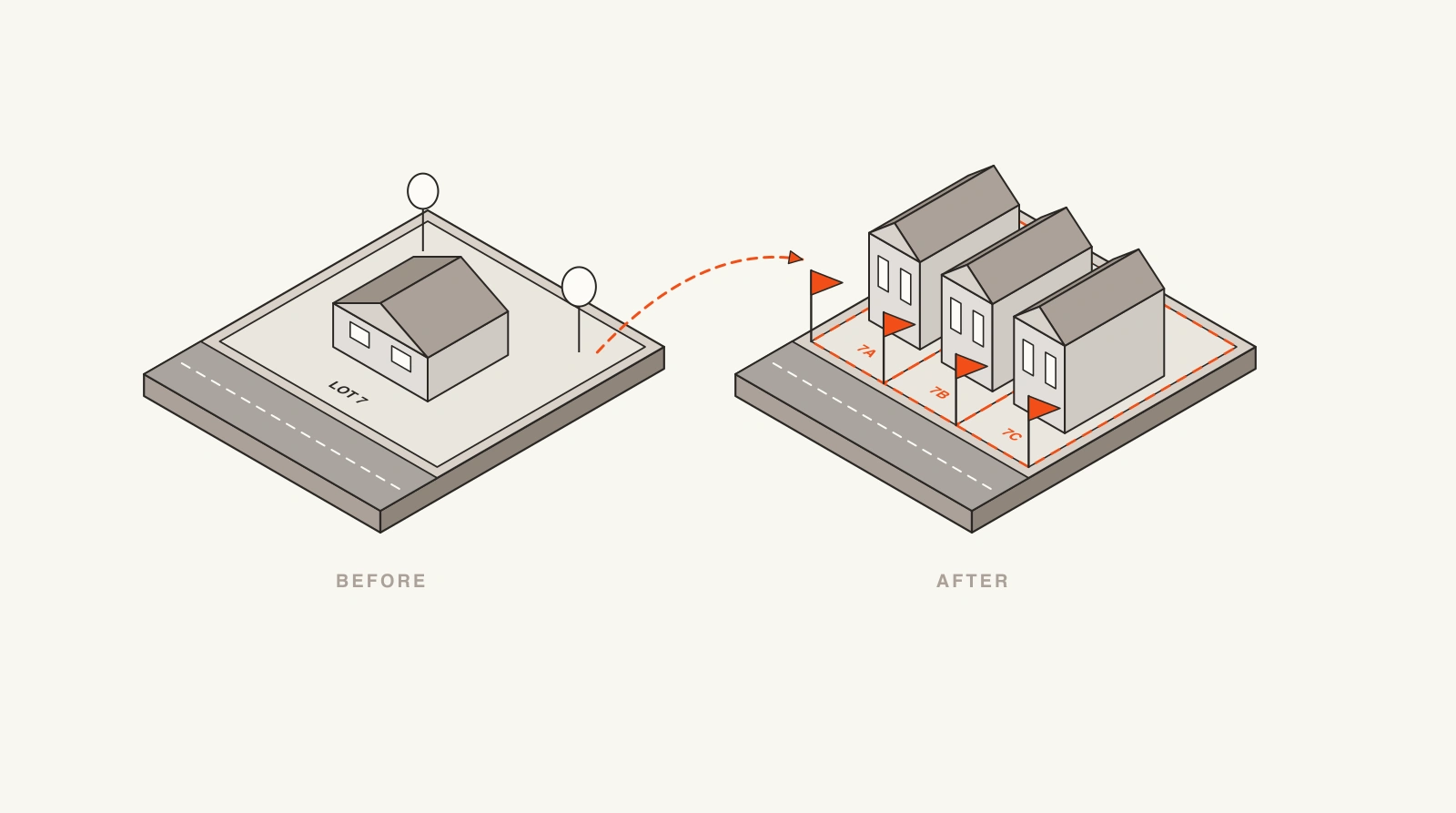
Quick definitions
A plat subdivides land that hasn't been subdivided before into numbered lots and blocks, with streets, easements and reserves. It's the first time the land becomes a recorded subdivision. Our plat guide covers the basics.
A replat is a new plat for land that's already in a recorded subdivision. It changes how that part of the subdivision is laid out: splitting a lot, combining lots, moving lot lines, or changing easements or building lines. Once recorded, it replaces the original plat for the lots it covers; the rest of the subdivision stays on the original plat.
Plat vs. replat, side by side
- Land: a plat covers raw or unplatted land; a replat covers land that's already part of a recorded subdivision.
- Purpose: a plat creates lots, streets and easements for the first time; a replat changes existing ones.
- Size: plats often cover dozens or hundreds of lots; replats usually cover one lot or a handful.
- Timeline: a new subdivision plat can take months to a year with engineering; a simple replat often takes a couple of months.
- Notice and hearing: some residential replats in Texas require mailed notice to nearby owners and a public hearing; most new plats don't, unless the local ordinance adds one.
- Typical reasons: a plat is for a new subdivision or commercial development; a replat is for lot splits, lot combinations, easement changes and corrections.
Why people replat
Lot splits and combinations are the replats that usually mean construction is coming, especially when the land recently sold or the owner is a new LLC.
- Lot splits. One lot becomes two or more, usually for townhomes or infill houses. This is the classic inner-loop Houston replat: an older house on a 50-by-100 lot, replatted into two or three narrow lots.
- Lot combinations. A developer buys neighboring lots and replats them into one larger site for a bigger building, townhome cluster or commercial project.
- Easement or building line changes. An easement or setback is moved or removed because it's in the way of a planned building. Often the first step before construction.
- Corrections. Fixing a surveying error or matching a newer survey. Usually paperwork, not construction.
Replats, amending plats and hearings in Texas
Texas Local Government Code Chapter 212 lets a lot be replatted without vacating the original plat, as long as the replat is signed and approved like any other plat. If the area was limited to residential use of no more than two units per lot in the preceding five years, by zoning or by a deed restriction in the original plat, the replat generally needs mailed notice to owners in the original subdivision within 200 feet and a public hearing. Rules and exceptions vary, so check with the city's planning department.
For small changes there's the amending plat: correcting a dimension or a label, or moving a lot line between neighbors who both agree, without a full replat. Amending plats are usually approved by staff, with no hearing.
If you see a sign on your street announcing a replat or a variance, the hearing is the place to ask questions or object. Most replats that meet the rules get approved, though; the city's role is to check them against the subdivision ordinance, not whether the neighborhood likes them.
Replats in Houston
Houston has no zoning, so lot size and density are mostly controlled by the subdivision rules in Chapter 42 of the city code and by private deed restrictions. Replats go through the Planning Commission on the same two-week cycle as new plats, and the agenda labels each item by type, so you can tell a replat from a new subdivision at a glance.
groundranger tracks every item on those agendas. Browse recent Houston plats and replats, or search a street to see whether a replat has already turned into building permits.
Recent Houston plats and replats
From recent Houston Planning Commission agendas: new subdivisions alongside lot splits and replats.
- 661
- plats on the agenda, last 90 days
- 6,620
- lots proposed
- 26,655
- acres platted
- Haddick PlaceDec 3, 20263 lots · 0.29 ac · Single Family Residential (Public Street) · East Houston
- ARG Chetti HoldingsDec 3, 20261.20 ac · Commercial · 77406
- Reserve at Spring BranchDec 3, 202670 lots · 4.65 ac · Landscape or Open Space; Residential Guest Parking; Single Family Residential (PAE 1/PAE 2) · Spring Branch Central
- Morse Street ViewsDec 3, 20262 lots · 0.11 ac · Single Family Residential (Public Street) · Neartown - Montrose
- Northwest Place Partial ReplatDec 3, 202614.71 ac · Unrestricted · Fairbanks / Northwest Crossing
- Spring Dell DevelopmentDec 3, 20260.61 ac · Unrestricted; Commercial · 77388
What the difference means for builders and trades
Watch both: plats give you time to build relationships, and replats are a short fuse for quoting work that's about to start. Once the permits are filed, they show up on the permit map.
- New plats tend to be bigger projects with longer timelines, often six months to more than a year before the first building permit. The builder and trades may not be picked yet.
- Replats move faster. The owner often has financing and a builder lined up, and permits can follow within a few months. Get in early or the trade list may already be set.
groundranger Pro
Get new plats and permits by email
Everything above, checked for you every morning. Pick your ZIP codes and the kind of work you want, and we email you new filings with the owner, contractor and design firm already attached.
Questions
What is a replat?
A new plat for land that's already in a recorded subdivision, used to split lots, combine lots, move lot lines or change easements. Once recorded, it replaces the original plat for the lots it covers.
What is the difference between a plat and a replat?
A plat divides land into lots for the first time. A replat changes lots that were already platted. Replats are usually smaller and faster, but some residential replats in Texas require notice to neighbors and a public hearing.
What is an amending plat?
A simpler kind of replat for minor changes, like fixing a dimension or label or moving a lot line between two consenting neighbors. In Texas it's usually approved by staff without a hearing.
Does a replat cancel the original plat?
Only for the lots it covers. The rest of the subdivision stays governed by the original recorded plat.
Can a replat be denied?
Yes, if it doesn't meet the subdivision rules, such as minimum lot size, frontage, drainage or access requirements. Neighbors can speak at a required hearing, but a replat that meets the rules is generally approved.
Do deed restrictions still apply after a replat?
A replat doesn't erase private deed restrictions. Many Texas cities won't approve a replat that conflicts with them, and the restrictions can still be enforced by the HOA or neighbors.