What platting means
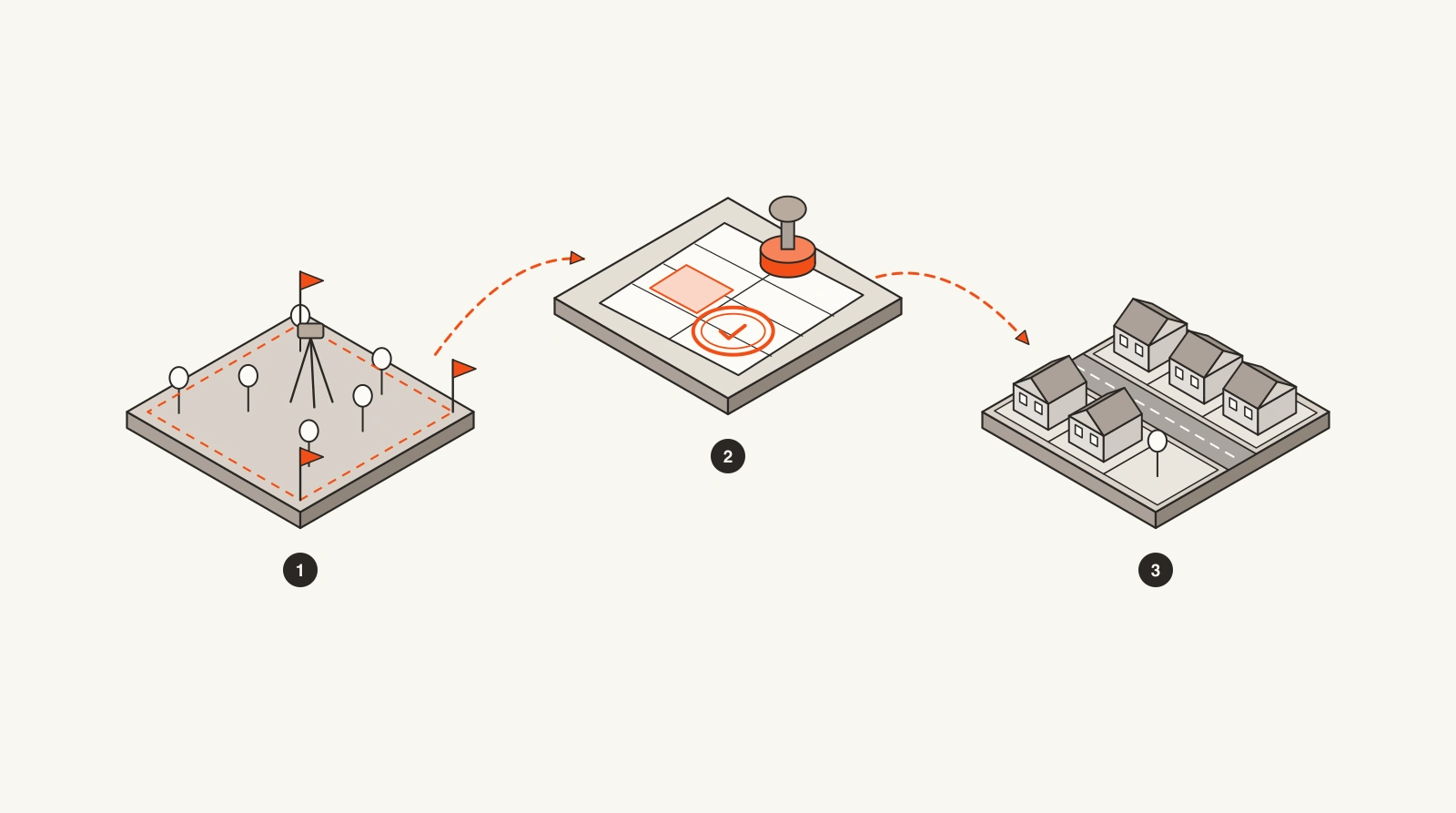
Platting turns one parcel into a recorded subdivision: numbered lots that can be sold, financed and permitted on their own. The result is a plat, a scaled map with a legal description that becomes binding once it's recorded with the county.
In Texas, platting is governed by the Local Government Code: Chapter 212 for land inside a city or its extraterritorial jurisdiction (ETJ), and Chapter 232 for unincorporated county land. Each city and county adds its own subdivision ordinance on top. Where platting is required, land generally can't be divided into lots for sale or get a building permit until it's platted.
The five steps of platting
The names vary by city, but nearly every plat goes through these five steps. Larger subdivisions split the approval into a preliminary plat and a final plat; see preliminary vs. final plat for that version.
- 1
Survey and drafting (about 2 to 8 weeks)
A licensed surveyor runs a boundary survey and drafts the plat: lot lines, blocks, easements, rights-of-way, reserves and the legal description. Odd boundaries, existing easements or floodplain on the tract stretch the timeline.
- 2
Pre-application meeting (about 1 to 3 weeks)
Most cities offer, and some require, an informal meeting with planning staff before filing. Staff flag required street widening, drainage problems and access issues while they're still cheap to fix.
- 3
Formal submission
The owner files the plat with the planning department, with fees and supporting documents: proof of ownership, tax certificates, drainage information and the surveyor's seal. From here the application is a public record.
- 4
Review and revision (often 4 to 12 weeks)
Planning, engineering, public works, utilities and fire review the plat against the subdivision rules. Comments go back, the surveyor revises, and the plat is resubmitted. Street dedications, utility extensions and detention get settled here.
- 5
Approval and recording
The planning commission votes on the plat at a public meeting; small and amending plats are often approved by staff. Once approved and any conditions are met, the plat is recorded with the county clerk and the new lots legally exist.
How long platting takes
Since 2019, Texas cities and counties have to approve, approve with conditions, or deny a complete plat application within 30 days of filing. A conditional approval or denial has to say why, and the applicant can respond and get a decision on the response. The applicant can agree in writing to extend the clock. The 30 days only start once the application is complete, so the real time goes into drafting, engineering and getting the application complete.
End to end, a new subdivision with streets and utilities usually takes several months to a year from first survey to recording. A small plat or replat with no new streets can be done in a couple of months.
In Houston, the Planning Commission hears plats every two weeks, so a clean application moves on a predictable cycle. groundranger tracks each agenda; see recent Houston plats.
Platting requirements
The details are in each city's or county's subdivision ordinance, but most ask for the same core items:
- A boundary survey and plat by a licensed surveyor. Every lot line traces back to it.
- Lots and streets that meet the subdivision rules: minimum lot size and frontage, street width, block length and access.
- Right-of-way dedication where the city's thoroughfare plan calls for a wider street along the tract.
- Utility and drainage easements wide enough to serve every lot.
- Drainage analysis and detention. Larger plats must show they won't increase runoff, often by setting aside a detention reserve.
- Tax certificates showing property taxes on the tract are paid.
- Signatures from every owner and lienholder with a recorded interest in the land.
Who's involved
- Owner or developer: starts the plat, pays for it and signs the owner's dedication.
- Surveyor and civil engineer: draft the plat, answer review comments and seal the survey.
- Planning department: takes in the application, routes it to other departments and recommends action.
- Reviewing departments: engineering, public works, utilities and fire, each checking against its own standards.
- Planning commission: approves, conditionally approves or denies the plat at a public meeting.
- County clerk: records the approved plat, which is when the lots legally come into being.
Plats moving through Houston right now
Here's what was on recent Houston Planning Commission agendas: new subdivisions, commercial reserves and lot splits, each one at the approval step of the process above.
- 661
- plats on the agenda, last 90 days
- 6,620
- lots proposed
- 26,655
- acres platted
- Haddick PlaceDec 3, 20263 lots · 0.29 ac · Single Family Residential (Public Street) · East Houston
- ARG Chetti HoldingsDec 3, 20261.20 ac · Commercial · 77406
- Reserve at Spring BranchDec 3, 202670 lots · 4.65 ac · Landscape or Open Space; Residential Guest Parking; Single Family Residential (PAE 1/PAE 2) · Spring Branch Central
- Morse Street ViewsDec 3, 20262 lots · 0.11 ac · Single Family Residential (Public Street) · Neartown - Montrose
- Northwest Place Partial ReplatDec 3, 202614.71 ac · Unrestricted · Fairbanks / Northwest Crossing
- Spring Dell DevelopmentDec 3, 20260.61 ac · Unrestricted; Commercial · 77388
Why builders and trades watch platting
Each step of platting gives away something about the project. The application names the developer and the engineering firm. The plat states the lot count, acreage and land use, which tells you the size and kind of construction coming. The commission agenda dates it. Someone watching plats sees projects months before the first building permit, while builders are still lining up their trades.
After the plat is recorded, the next public signals are permits and, for commercial projects over $50,000, state accessibility registrations. groundranger puts all three on the permit map and on every city page, like Houston, and Ranger can search them in plain English.
groundranger Pro
Get new plats and permits by email
Everything above, checked for you every morning. Pick your ZIP codes and the kind of work you want, and we email you new filings with the owner, contractor and design firm already attached.
Questions
What is the platting process?
The legal process of dividing land into recorded lots. A surveyor drafts the plat, the owner files it with the city or county, departments review it, the planning commission (or staff, for small plats) approves it, and the county clerk records it.
How long does platting take in Texas?
Once a complete plat application is filed, Texas cities and counties must act on it within 30 days. Counting survey, engineering and revisions, a new subdivision usually takes several months to a year; a small plat or replat can take a couple of months.
How much does platting cost?
It depends on the jurisdiction and the land. The main costs are the survey and plat drafting, engineering and drainage studies, application and recording fees, and for new subdivisions, the streets and utilities the city requires.
Who approves a plat in Texas?
Inside a city or its ETJ, the city's planning commission or governing body, under Local Government Code Chapter 212. In unincorporated areas, the county commissioners court, under Chapter 232. Many small and amending plats can be approved by staff.
Can you build on unplatted land?
Inside a city or its ETJ, usually not until the land is platted or qualifies for an exemption, because permits are withheld. In unincorporated county areas, rules vary, and some rural tracts can be built on without a plat.
Is platting the same as zoning?
No. Zoning controls what can be built (use, density, height). Platting controls how land is divided into lots, streets and easements. Houston has no zoning, but platting is still required.