The short answer
There's no statewide general contractor license in Texas, and no state license for residential builders or remodelers. (Texas had a Residential Construction Commission that registered home builders, but the Legislature abolished it in 2009.) A general contractor in Texas operates as a business that follows local rules, not as a state license holder.
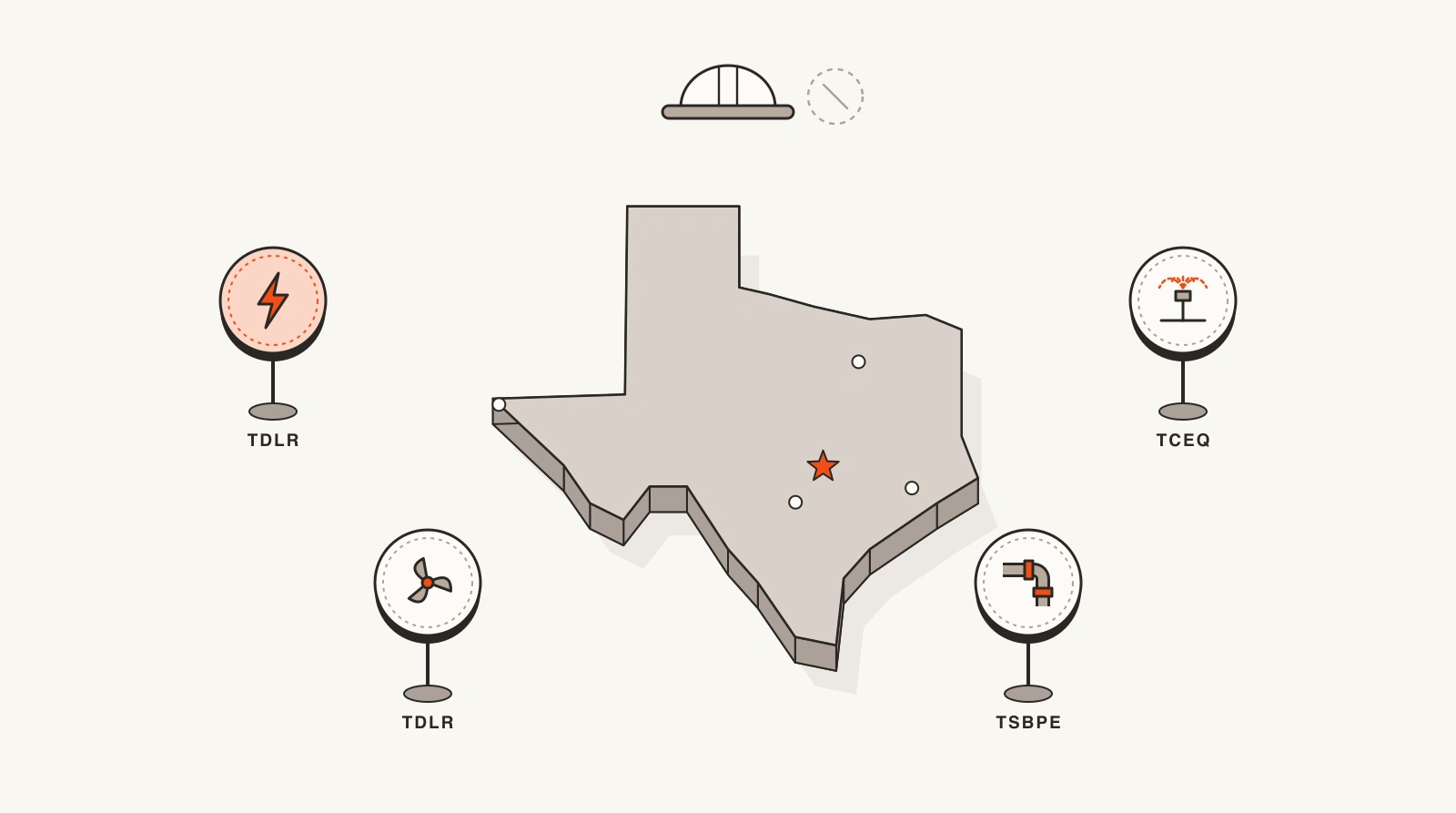
What Texas does license are specific trades. If the work touches wiring, refrigerant, plumbing or irrigation, the person doing it needs a state license. And most large cities require contractors to register locally before pulling permits. So: probably no state license if you're a GC, a state license if you're in a licensed trade, and local registration plus insurance either way.
Trades Texas does license
If you subcontract all the trade work, you don't need these licenses yourself, but you're responsible for hiring subs who have them. You can check any license on the agency's public license search: TDLR, TSBPE and TCEQ.
- Electricians: TDLR. The Texas Department of Licensing and Regulation licenses electricians (apprentice, journeyman, master and other classes) and electrical contractors. An electrical contractor needs a master electrician on staff, and electrical permits are pulled by licensed electrical contractors.
- Air conditioning and refrigeration: TDLR. A/C and refrigeration contractors are licensed by TDLR, and technicians working under them must be registered or certified. The licensed contractor pulls the mechanical permit.
- Plumbers: TSBPE. The Texas State Board of Plumbing Examiners licenses plumbers, from apprentice through master, and plumbing companies work under a responsible master plumber. Plumbing permits are pulled under that license.
- Irrigators and backflow testers: TCEQ. The Texas Commission on Environmental Quality licenses landscape irrigators, who design, install and repair irrigation systems, and backflow prevention assembly testers.
- Others at TDLR: elevator contractors and inspectors, boiler inspectors, water well drillers and pump installers, and Registered Accessibility Specialists (more on those below).
City contractor registration
Because the state leaves general contractors alone, cities fill the gap. Registration is not a license (there's no exam), but without it you can't pull permits. How the biggest cities handle it:
- Houston: no general contractor license or registration to buy a building permit; an owner, agent or contractor can buy it. Trade permits are different: electrical and A/C contractors must register their state licenses with the city before buying trade permits, and only licensed contractors can buy them. Sidewalk and driveway permits require a bonded contractor.
- Dallas: contractors must register with the city before permits are issued, and the permitting system checks registration and insurance on file. General contractor registration lists the people authorized to sign permit applications. Homeowners can pull some permits for their own homestead under an exemption.
- Austin: general contractors, trade contractors and homeowners acting as their own contractor must register with the city's Building and Trade Contractor Services before getting a building or trade permit. A general contractor registers once; trade contractors update their registration with their current state license each year.
- San Antonio: no license or registration for commercial general contractors. Residential contractors must register as a Home Improvement Contractor (non-structural) or Residential Home Builder (structural), which includes a background check. Trade permits require a licensed trade contractor.
- Other cities: Fort Worth, Plano, Frisco and most suburbs have their own registration for general and trade contractors. Check the building department of each city you work in, and remember that unincorporated county areas often issue few or no building permits at all.
Insurance and bonds
Insurance and bonding requirements come from cities, owners and the law on public work rather than from a license, but they're just as real a gate:
- General liability. Many cities require proof of liability insurance to register, and nearly every commercial owner and GC requires it in the contract, often with higher limits than the city minimum.
- Workers' compensation. Texas is the one state where private employers can choose not to carry workers' comp. But contractors on public projects for a government entity must provide coverage for everyone on the job, and most commercial GCs require it from their subs.
- Payment and performance bonds. Texas public works contracts require bonds under Government Code Chapter 2253: a performance bond on contracts over $100,000 and a payment bond on contracts over $25,000. Private owners and lenders often ask for them too on larger jobs.
- License and permit bonds. Some cities require a small surety bond for certain permits, like Houston's sidewalk and driveway permits.
TDLR accessibility registration on commercial projects
One state requirement does apply to most commercial building projects. Under the Texas Architectural Barriers Act, a project with an estimated construction cost of $50,000 or more must be registered with TDLR, and its construction documents must be reviewed by a Registered Accessibility Specialist (RAS) for compliance with the Texas Accessibility Standards (TAS). After construction, a RAS inspects the finished project. Smaller projects can register voluntarily, and some local building officials require it.
The owner or design professional usually handles registration, but the GC should confirm it's done: missing TAS review and inspection can hold up a certificate of occupancy and cause costly rework.
Each registration becomes a public record with the project name, address, estimated cost, owner, tenant and design firm, usually months before construction starts. groundranger tracks these filings as upcoming commercial projects and shows them alongside city permits on the permit map.
Commercial projects registered recently
Recent Texas commercial projects from TDLR accessibility registrations and city permits. Each one is a job that will need a GC and licensed trades.
- 3,697
- commercial projects filed, last 30 days
- 673
- of them 10,000+ sq ft
- 6,116
- residential projects filed
- 650 S Griffin St · City Of DallasNov 12, 2026Evolve concepts has been contracted by hyrox to install and subsequently remove three temporary, freestanding modular structures inside the kay bailey hutchinson convention center at 650 s griffin st, dallas, tx 75202 for a hyrox athletic competition. the installation consist of two elevated spectator viewing platforms and one elevated pedestrian course bridge. the structures will be assembled using engineered modular components, with stairs, guardrails and supporting structural elements as detailed in the submitted drawings. all structures are temporary, will be removed following the event, and will not involve permanent modifications to the existing building · 75202
- 7051 Burleson Rd · Ctx Burleson IndustrialNov 10, 2026Tech west industrial · 78744
- 1720 Lawrence St · Housing Authority Of The City Of AustinNov 9, 2026Eplan: commercial expedited review - *smart housing* new parking garage - also contains maintenance and dog wash. (142662 sq ft) · 78741
- 5399 Twin Sixties Dr · Trammell Crow CompanyNov 6, 2026Bu zo pl el class c commercial swimming pool · 75206
- 2201 N Stemmons Fwy · Anatole Partners, Iii, Llc.Oct 30, 2026Mcr project name:trinity ballroom and exhibit renovation location address:2201 n. stemmons hwydallas, tx 75207 · 75207
- 12100 Samsung Blvd · Samsung Austin SemiconductorOct 28, 2026Sas fire water pump building - diesel generator — renovation/alteration — installation of a concrete maintenance access platform pad for a diesel generator and associated offload containment to support the fire water pump building · 78754
- 7630 Arapaho Rd · Richardson ISDOct 27, 2026Dsst-risd westwood ms storm shelter · 75248
- 8200 Walnut Hill Lane · Texas Health ResourcesOct 22, 2026Thr mri relocation & 3rd ct — renovation/alteration — renovating offices to be a new mri suite with two mris, and renovating an mri room to be a new ct room. - 9600 sq ft · 75231
Getting set up to work in Texas
Rules change and differ by city, so treat this as the shape of the process and confirm each step with the agency involved:
- 1
Form and register the business
Set up your entity with the Texas Secretary of State (or operate as a sole proprietor with an assumed-name certificate) and get your federal and state tax registrations.
- 2
Get the trade licenses that apply
If you'll do electrical or A/C work yourself, get licensed through TDLR; plumbing through the TSBPE; irrigation or backflow testing through TCEQ. If you'll sub all of it out, verify each sub's license.
- 3
Get insured
Carry general liability, and workers' comp if you have employees or plan to bid public or commercial work. Ask the cities and GCs you'll work with for their minimums.
- 4
Register with each city
Register with the building department in each city where you'll pull permits: Dallas, Austin and San Antonio (residential) all require it, and trade contractors register their state license in Houston.
- 5
Pull permits and build
With all of that in place, you and your licensed trades can pull building and trade permits. On commercial work over $50,000, confirm the project is registered with TDLR for accessibility review.
Licensed and registered: now find the work
Texas's light licensing for general contractors means low barriers to entry and a lot of competition for the same jobs. The contractors who win consistently are the ones who hear about projects first. Every project above leaves a public trail: plats, TDLR registrations and permits. See the permit map for what's being filed near you, Ranger to search projects in plain English, or our guide to finding construction leads.
groundranger Pro
Get new projects in your area by email
Everything above, checked for you every morning. Pick your ZIP codes and the kind of work you want, and we email you new filings with the owner, contractor and design firm already attached.
Questions
Do you need a license to be a general contractor in Texas?
No. Texas has no statewide general contractor or home builder license. General contractors need local registration in many cities, insurance, and licensed subs for electrical, A/C and plumbing work.
Which trades require a state license in Texas?
Electricians and air conditioning and refrigeration contractors (TDLR), plumbers (Texas State Board of Plumbing Examiners), and landscape irrigators and backflow testers (TCEQ). TDLR also licenses elevator contractors and Registered Accessibility Specialists, among others.
Do I need to register with the city to pull permits?
In many cities, yes. Dallas and Austin require contractors to register before permits are issued, San Antonio requires it for residential contractors, and Houston requires electrical and A/C contractors to register their state licenses. Houston doesn't require a general contractor license for building permits.
Can a handyman work without a license in Texas?
Minor repair work that doesn't touch electrical, plumbing, A/C or irrigation generally doesn't need a state license. City registration and permit rules still apply, and any licensed-trade work needs a licensed contractor.
Is workers' comp required in Texas?
Private employers can choose not to carry it, which is unique to Texas. It's required for contractors on public projects for government entities, and most commercial owners and GCs require it from their subcontractors.
What is TDLR project registration?
Under the Texas Architectural Barriers Act, building projects with an estimated construction cost of $50,000 or more must be registered with TDLR and reviewed and inspected by a Registered Accessibility Specialist for compliance with the Texas Accessibility Standards.